Serving on boards, both corporate and non-profit, is a very rewarding experience. Not financially — but in the sense that you have been able to help with a new idea, or to share an experience that can be helpful. I have been privileged to have served on a number of boards. The two largest organizations have term limits. One was at 9 years, the other at 12. I hated to leave those boards but totally support the idea of term limits. I wish Congress believed in them. As of a few years ago, I had phased out of all board service. But, then along came an invitation to which I could not say no.
In 2015, an attorney friend of mine in Florida convinced me to write a book about our election system. In 2016, I published Election Attitude – How Internet Voting Leads to a Stronger Democracy. In my research for the book, I could not find any significant traces of fraud, but I did find many examples of people who were registered voters but could not vote. Some were sick or infirm and could not get to the polling place. Others were not given time off by their employers, or were disabled. I wrote about how mobile voting with blockchain technology could provide a way to vote which was safe, secure, private, and verifiable. There were many believers but most politicians resisted the idea.
In 2021 Ramon Perez started a related idea called the Digital Democracy Project (DDP). The concept uses mobile voting technology to give registered voters a say on state legislation. Ramon says, “It’s easy: voters weigh in on bills during the debate, then legislators can see online what voters want on those bills and vote the will of the people.” The system is called Voatz, real election software which has been certified in several States, Canada, and Mexico. Voatz verifies each voter is a real human being and registered to vote in the same district which the legislator represents. Voatz has expanded so all U.S. voters can have a say in Congress, as well as 7 state legislatures. With the Digital Democracy Project is not exactly the same as voting, but it gives voters a strong voice which representatives can hear.
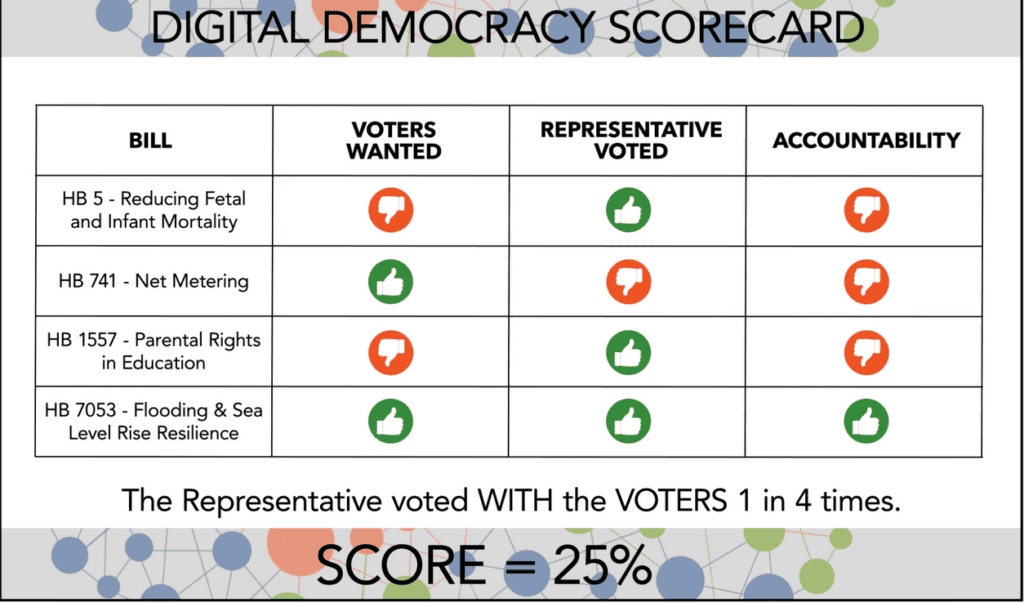
How it works: Vote – Tally – Score. Digital Democracy Project (DDP) is mobile voting and accountability tracking technology. Voters cast ballots on current legislation, then DDP compares what voters want to how legislators deliver. Voters can use the legislative accountability scores to make more informed choices on Election Day.
- Vote: DDP partners with the blockchain-backed Voatz app for identity and ballot security. Voters cast ballots on the app or DDP website.
- Tally: DDP aggregates totals by district and issue, not party, to inform representatives of the majority’s will.
- Score: Following legislative sessions, DDP publishes an online, public accountability scorecard tracking how well officials delivered on constituent demands.
Elected officials want to be RE-elected officials. DDP puts powerful accountability in voters’ hands. It may shift the political incentive structure to listen to the voters.
Ramon Perez is an AI technology executive, military veteran, TEDx speaker, and the founder and executive director of the nonprofit 501(c)3, nonpartisan Digital Democracy Project. I serve on the board.