
s
For as long as I can remember, I have believed the sun would ultimately be our main source of power. The sun is a nearly perfect sphere of hot plasma, roughly 4.6 billion years old, which generates energy through nuclear fusion, a science which has attracted billions of dollars for research to reproduce fusion on Earth. The sun reaches 15 million degrees centigrade at its core. Sunlight leaves the sun’s surface and reaches Earth about 8 minutes and 20 seconds later. The challenge is how to convert the sunlight into electricity.
Solar’s story stretches back nearly two centuries, but its explosive growth has really happened in just the last 15 years. In 1839, French physicist Edmond Becquerel discovered the photovoltaic effect. In 1883, American inventor Charles Fritts built the first working solar cell, converting light to electricity at roughly 1% efficiency, too weak to be practical. In 1954, scientists at Bell Labs created the first practical silicon solar cell with 6% efficiency. Today’s typical rooftop panel is pushing 25–26%, and the research frontier is closing in on 35%
This year, the U.S. surpassed 6 million cumulative solar installations — spanning residential rooftops, commercial buildings, community solar projects, and utility-scale farms. About 97% of those installations are on residential rooftops — roughly 5.8 million homes. That works out to about 9% of U.S. homes currently having solar, up from around 7% in early 2025, and projections it will climb to 11% by 2030.
In the United States, solar amounted to roughly 9% of total electrical generation. Solar met about 61% of the growth in U.S. electricity demand in 2025. In China, the solar share was about 11%, nearly double its 2020 level. China is adding more new solar generation each year than the rest of the world combined. China manufactures 80-85% of global solar panels. The United States manufactures a little less than 2%, but is growing rapidly. Tesla has big plans.
Twenty-five years ago, I attended a technology conference in New York. One of the speakers was Elon Musk. I had never heard of him and he was not a good speaker. He described his vision of powering our homes and our cars with solar. He said the vision also included a global network of EV charging stations. I think most of the audience thought it was a pipe dream. Today, roughly 80,000+ Supercharger stalls make up Tesla’s official public fast-charging network, while well over 50,000 additional Wall Connectors are installed at businesses plus an unknown but likely much larger number — probably millions — installed in private homes. I would not bet against Elon Musk.
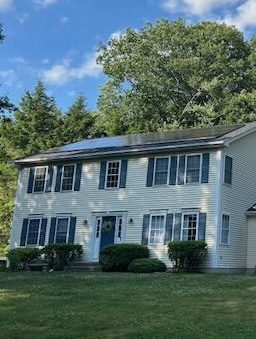
My oldest son has a Tesla solar system. The 35 panels he has are made at Tesla’s Gigafactory in Buffalo, NY. He has two Tesla Powerwalls (battery backups) which are made at Tesla’s Gigafactory in Nevada are installed in his backyard close to the house. The system uses AI to optimize the use of electricity.
The system includes a very cool home electricity app. It shows in real-time where the energy is coming from and where it is going. For example, if the sun is bright, the roof may convert it to 10-15 Kw. If the house is using 5 Kw, the excess 5-10 Kw goes to the Powerwalls. If the Powerwalls are fully charged, the excess gets exported to the utility company and is converted to a credit on my son’s electric bill. If its a cloudy day and no power is being generated by the roof, then the Powerwalls provide what the house needs. If the Powerwalls are run down, the house gets its power from the grid. The system checks for weather alerts and if there is an impending heavy storm, the system prioritizes power to charge the Powerwalls. All of this is automated. I believe this is the future.
I love to read books. All the books I have written and the books I have read are in my profile at Goodreads. Feel free to view it here.