
This week, I am taking a short break from my AI in Our World series to write about something unfolding outside my window.
From our oceanfront home in Florida, I can watch the beach change as the tide rises and falls. Today, I watched the incoming water approach recently planted sea oats. These plants help protect the dunes, yet the ocean appeared to be threatening them. One of the Hammock Dunes community walkovers where we live had already been closed because of high-tide damage.
I took this photograph from our terrace earlier this week.
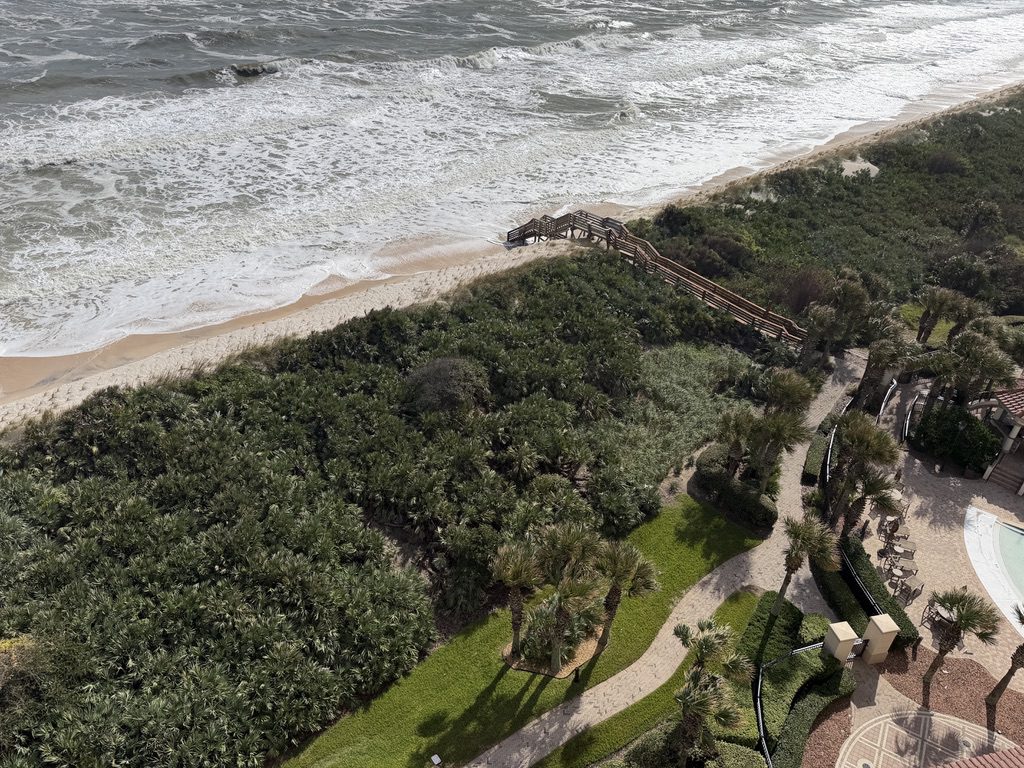
The view from my terrace: breaking surf, a narrow strip of exposed beach, and the vegetation separating the ocean from our community. Photograph by John Patrick.
The picture captures how little beach can remain between the waves and the dunes. The wooden crossing provides a familiar reference point as the water advances and retreats. Looking down, I began thinking about the forces moving all that water—and the plants helping hold the shoreline together.
The tide begins with gravity. The Moon pulls more strongly on the side of Earth nearest to it than on the far side. Those differences create tide-generating forces. The Sun contributes as well. As Earth rotates, coastlines experience the resulting rise and fall of ocean water. Ocean depths and the shape of the coastline influence the tides at each beach. NOAA explains tides.
Along much of Florida’s Atlantic coast, there are two high tides and two low tides during a lunar day, approximately 24 hours and 50 minutes. High and low water occur roughly six hours apart, although local timing varies. Because the Moon continues moving along its orbit while Earth turns, the tides generally arrive later each day. NOAA on tidal timing.
The difference between high and low water also changes throughout the month. Around new and full moons, the Sun, Moon, and Earth line up, reinforcing the tidal effect. High tides tend to be higher and low tides lower. These are called spring tides, regardless of the season. Around quarter moons, their effects partially offset each other, producing the smaller tidal range of neap tides. NOAA on spring and neap tides.
“King tide” is a popular name for an exceptionally high tide like what we experienced this week. However, a photograph alone cannot establish why the water reached a particular height. Winds, ocean currents, and weather can add to the astronomical tide. Winds that day were 20 MPH with gusts to 30 MPH. Rising sea levels raise the starting point from which tides operate. Explaining today’s conditions would require local tide and weather records. NOAA on king tides, and high-tide flooding.
The white surf in my photograph illustrates another important distinction. The tide changes the underlying water level over hours. Individual waves ride on that surface and rush up the beach. Higher water allows waves to reach farther inland, sometimes removing sand from the base of a dune. NOAA on coastal water levels and erosion.
This is where sea oats do their work.
Their stems and leaves slow the wind, allowing blowing sand to settle around them. As sand accumulates, the plants grow upward through it. Beneath the surface, roots and spreading underground stems called rhizomes help bind the sand. Over time, the plants help build and stabilize dunes. University of Florida on dune formation.
A dune provides a reserve of sand and a buffer between the ocean and the property behind it. Sea oats strengthen that buffer, but they cannot prevent every loss of sand when waves repeatedly reach its base.
These grasses tolerate salt spray, drought, harsh sunlight, and brief seawater flooding, but persistent saturation and erosion can still damage them. Newly planted sea oats also need time to develop an established underground network including the recent plantings here in Hammock Dunes and elsewhere along Flagler County’s beaches. A brief wash of seawater does not necessarily mean they will die, but water carrying away the sand around them is a concern. National Park Service on sea oats, U.S. Forest Service on growing conditions.
We can help by keeping off dune vegetation, using designated overwalks, and respecting closures. Those simple choices give the plants a better chance to become established and help damaged dunes recover.
From the terrace, the tide’s movement is easy to see. The work of sea oats is harder to notice. Much of it happens underground, or one small deposit of windblown sand at a time.
Watching the water approach those new plants made me appreciate how much is happening along that narrow boundary—and how much our community depends on it.
If you want to read about my opinion on AI in Our World, please visit my blog.