

I just finished reading The Chip: How Two Americans Invented the Microchip and Launched a Revolution by T.R. Reid. Reid did an enormous amount of research on all the names and technologies of the 1950s and 60s. I was an electrical engineering student from 1963 to 1967 so the book brought back a lot of memories. When he mentioned Andrew Grove of Intel and Steve Jobs, it brought back special memories because I had met them both.
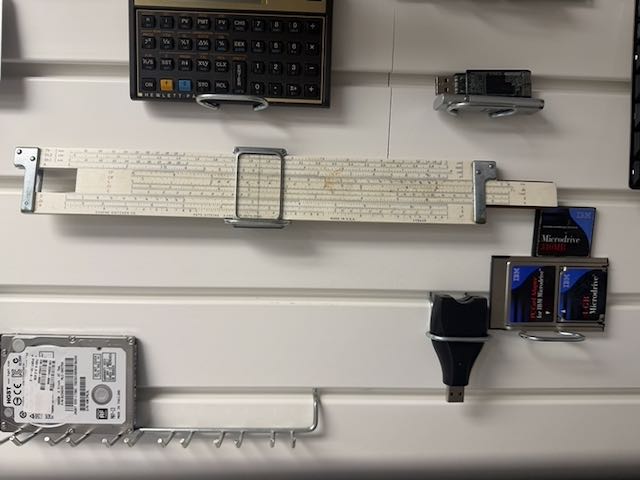
One of the key tools used by engineers in the 60s was the slide rule. The picture at the top is the technology museum in my workshop. You can see it just above the dark screen of my iMac. Below is a closer image of the slide rule I used in engineering studies. It was not an option. Every engineer and every engineering student had a slide rule to make their calculations for problem solving or engineering design. That was in the 60s. Today, if I show my slide rule to one of my grandchildren, they would say, “Pop-Pop, what is that?”. With the help of AI, I will share the history of slide rules. The slide rule was the pocket calculator which built the modern world.
Before electronic calculators, smartphones, and computers, engineers, scientists, pilots, and students carried a remarkable analog tool in their pockets: the slide rule. It was usually made of wood, plastic, or bamboo, with carefully printed scales and a sliding center strip. At first glance, it could look mysterious—a ruler covered in tiny numbers, letters, and lines. But for more than three centuries, the slide rule was one of humanity’s most important calculating tools.
The slide rule is a mechanical device for doing mathematical calculations quickly. It does not add and subtract in the usual straightforward way. Instead, it uses logarithmic scales to turn multiplication and division into the physical acts of sliding scales together.
With a slide rule, a user could calculate:
– Multiplication and division
– Squares and square roots
– Cubes and cube roots
– Logarithms
– Trigonometry, including sines, tangents, and cosines
– Scientific and engineering formulas
– Ratios, percentages, and conversions
The answers were typically approximate rather than exact. A skilled user might get three significant figures—often accurate enough for design work, navigation, science, and everyday technical calculations.
For example, someone multiplying 2 by 3 would align the “1” on one scale with the 2 on another scale, then find 3 and read the result: 6. The user had to know where the decimal point belonged, so mental arithmetic and estimation were essential parts of using a slide rule well.
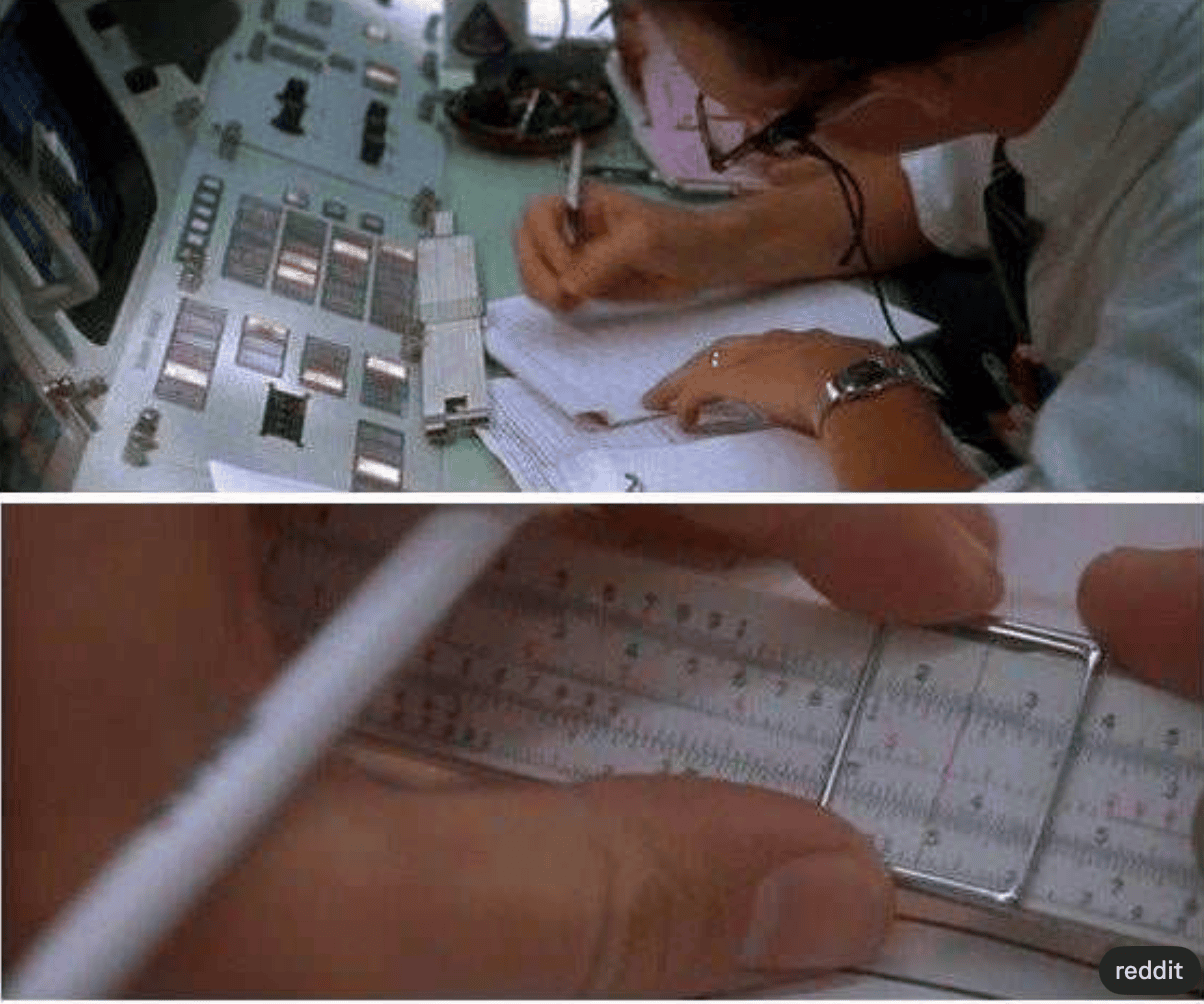
NASA using a slide rule for flight calculations
The slide rule emerged from the discovery of logarithms in the early 1600s. Scottish mathematician John Napier published his work on logarithms in 1614. Logarithms made difficult multiplication and division much easier by converting them into addition and subtraction.
Not long afterward, English clergyman and mathematician William Oughtred is generally credited with developing the first slide rule around 1622. His early version used circular logarithmic scales. Other inventors and instrument makers soon developed straight versions resembling the familiar slide rules used in later centuries.
– In the 1600s and 1700s, they were used mainly by mathematicians, surveyors, navigators, and technical specialists.
– During the Industrial Revolution, they became important tools for engineers designing bridges, railways, factories, engines, and ships.
– By the 1800s and early 1900s, manufacturers were producing durable, precise slide rules for professional use.
– In the mid-20th century, the slide rule became a standard item for engineering and science students.
Companies such as Keuffel & Esser in the United States, Faber-Castell in Germany, and Pickett became well known for high-quality instruments. Some models were simple enough for students, while others had specialized scales for fields such as aviation, electrical engineering, chemistry, or construction. My slide rule is a K&E.
For decades, a slide rule was as closely associated with engineers as a stethoscope is with doctors.
Scientists and engineers used them to work on projects which shaped the modern world, including:
– Aircraft and aviation systems
– Bridges, buildings, and highways
– Electrical networks and radio technology
– Chemical and industrial processes
– Space exploration
– Military and naval navigation
The Apollo program is one of the best-known examples. NASA engineers used slide rules during the planning and development of early space missions. Although large computers were also becoming important by that era, slide rules remained fast, portable, dependable, and useful for checking calculations.
A slide rule did not need batteries, an outlet, a software update, or an internet connection. It could be used on a desk, in a laboratory, on a construction site, or in an airplane cockpit.
The slide rule’s reign ended quickly in the 1970s.
In 1972, Hewlett-Packard introduced the HP-35, one of the first pocket scientific calculators. It could perform complex calculations with greater precision than a slide rule, and it could display a numerical answer directly. Texas Instruments and other companies soon made calculators more affordable and widely available.
Within only a few years, the slide rule changed from an everyday professional tool into a historical object.
By the late 1970s, most students no longer needed to learn how to use one. Electronic calculators were faster, more accurate, and easier for beginners. Later, personal computers and smartphones made manual calculation even less common.
Still, the slide rule deserves credit for helping create the world which made those devices possible.
Today, slide rules are collected by historians, engineers, teachers, and people who enjoy vintage technology (like me). They are also valuable educational tools.
Using one teaches several useful lessons:
– Numbers are not just symbols; they represent quantities and scale.
– Estimation matters.
– Precision should match the task.
– Technology can be elegant without being electronic.
– Understanding a method is different from simply receiving an answer.
There is something satisfying about using a slide rule. It is tactile and visual. Instead of pressing buttons and trusting a screen, the user sees the relationship between numbers unfold through motion and alignment.
In an age of instant digital answers, the slide rule reminds us that calculation was once a hands-on skill.
The slide rule may look old-fashioned, but it was once a symbol of innovation. It helped generations of people design machines, build infrastructure, fly aircraft, and explore space.
Its legacy is not merely historical. The slide rule represents a practical kind of intelligence: the ability to estimate, reason, check one’s work, and understand the scale of an answer. Long before the pocket calculator, the slide rule was the technology that helped people calculate their way into the modern age.
Once in a while, I grab my slide rule, just to see if I can remember how to use it. I am sure some of my senior readers will remember the slide rule well.